Linear Guide vs. Track Roller: No Better Option, Only the Best Fit

This article compares recirculating linear guides and track rollers, clarifying that neither technology is universally better—each fits specific working conditions. Linear guides offer micron-level precision and rigidity for clean, short-stroke applications, while track rollers thrive in contaminated, cost-sensitive, and cam-driven environments. A four-step decision tree, application table, and four hybrid case studies show how combining both often delivers the optimal solution.
Linear Guide vs. Track Roller: Official Definitions and Structural Analysis
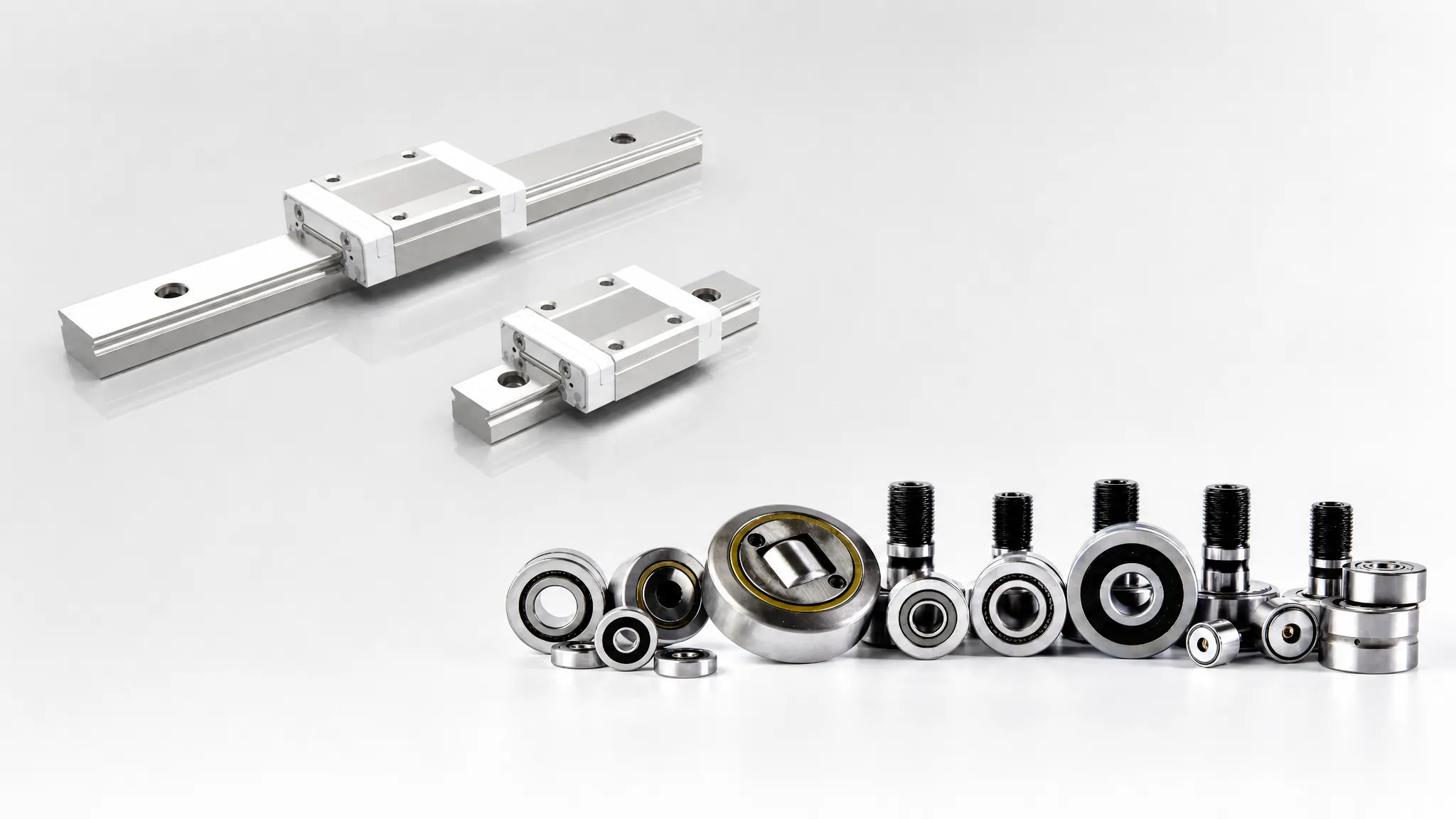
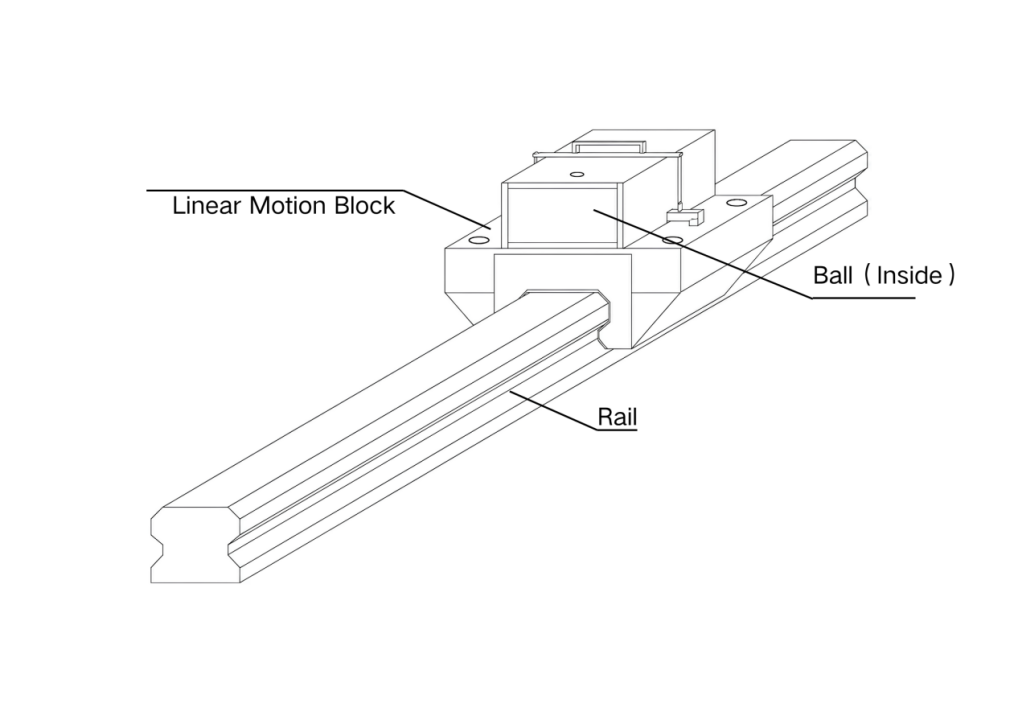
What is a Linear Guide?
When sourcing precision motion components, you may see many names for the same product: Recirculating Linear Ball Bearing (ISO standard), Linear Guideway (Japan's machine tool industry), LM Guide (THK), or Monorail Guidance System (German manufacturers).
Despite these different names, they all refer to the same core element: a linear guide.
A linear guide translates rotary bearing technology into linear motion. It uses balls or rollers that roll continuously inside a block. This replaces sliding friction with rolling friction, allowing heavy machines to move smoothly with micron-level accuracy.
What is a Track Roller?
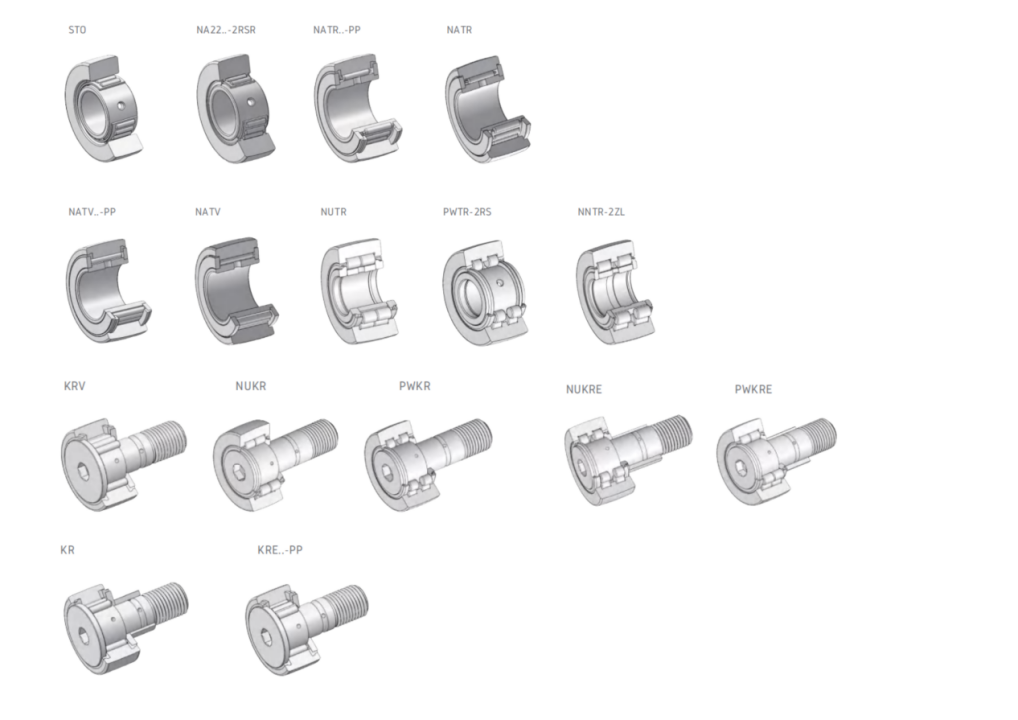
When looking at a track roller, many engineers ask: "Is this just a standard bearing with a thick outer ring?"
That is only half true. A track roller is built so the outer ring acts as a wheel. It runs directly on a rail, track, or cam surface.
These bearings are designed to take heavy radial loads and handle axial loads under specific conditions.
Linear Guide vs. Track Roller: Which is Better? There is No Absolute Answer, Only the Right Fit
Customers often ask "which one is better," but the professional answer is: there is no absolute best, only the choice that better fits your working conditions.
| Comparison Feature | Linear Guide | Traditional Track Roller | Winner |
| Positioning Accuracy | Extremely High (Micron-level) | Medium | Linear Guide |
| Running Speed | Medium | Higher | Track Roller |
| Structural Rigidity | Extremely High (4 Directions) | Medium-Low (Mainly Radial) | Linear Guide |
| Load Capacity | High | Medium | Linear Guide |
| Installation Requirements | High (Requires Precision Mounting Surface) | Low (Flexible Requirements) | Track Roller |
| Short-Stroke Cost | High | Low | Track Roller |
| Long-Stroke Cost | Very High | Lower | Track Roller |
| Lubrication Maintenance | Frequent | Minimal | Track Roller |
| Overturning Moment | Strong | Weak (Requires Multi-Bearing Combination) | Linear Guide |
| Motion Smoothness | Good (Slight Pulsation) | Smoother | Track Roller |
| Contamination Resistance | Poor | Good | Track Roller |
Selection Decision Tree: Linear Guide vs. Track Roller
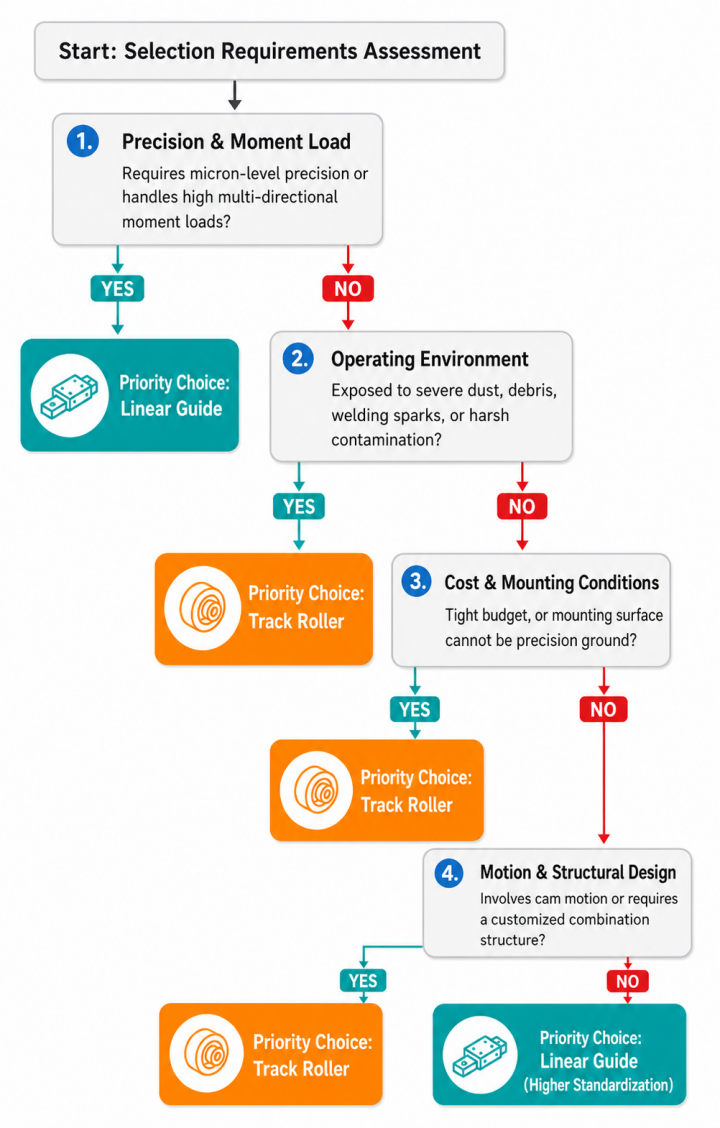
Before choosing between a linear guide and a track roller, evaluate your application through the following four steps.
1. Precision & Moment Load
Requires micron-level precision or handles high multi-directional moment loads?
[ Yes ]→Priority Choice: Linear Guide
[ No ]→Proceed to Next Step
2. Operating Environment
Exposed to severe dust, debris, welding sparks, or harsh contamination?
[ Yes ] →Priority Choice: Track Roller
[ No ] →Proceed to Next Step
3. Cost & Mounting Conditions
Tight budget, or mounting surface cannot be precision ground?
[ Yes ]→Priority Choice: Track Roller
[ No ] →Proceed to Next Step
4. Motion & Structural Design
Involves cam motion or requires a customized combination structure?
[ Yes ]→ Priority Choice: Track Roller
[ No ]→Priority Choice: Linear Guide (Higher Standardization)
Typical Application Equipment Comparison: Linear Guides vs. Track Rollers
| Equipment Type | Preferred Solution | Core Engineering Logic |
| High-Speed Engraving & Milling Machine | Ball Linear Guide | Low friction, high speed response, micron-level accuracy |
| Laser Cutting Machine | Ball / Roller Linear Guide | Balance of precision and speed, high dynamic response |
| Precision Surface Grinder | Roller Linear Guide | High accuracy retention, extreme rigidity, vibration resistance |
| Conveyor System | Track Roller | Continuous rotation, radial load capacity, good straddle support rigidity, low single-wheel replacement cost |
| Forklift | Stud Type / Yoke Type Track Roller | Heavy load, shock resistance, low speed, deformation-resistant thick outer ring, mast lifting guidance |
| Printing Machinery | Track Roller | High-precision rotation, low radial runout, continuous operation, dustproof sealing |
| Material Handling | Track Roller | Heavy load, low speed, continuous operation, versatile spare parts, low replacement cost |
Hybrid Applications: Combining Linear Guides and Track Rollers
In real-world equipment design, engineers often use a hybrid approach rather than relying on a single technology. This is driven by two main reasons:
Varied Operating Conditions: Different axes carry different load directions, precision requirements, and environmental conditions. No single component fits all needs.
Cost Efficiency: Combining both technologies ensures core positioning accuracy while significantly reducing manufacturing and maintenance costs.
Case 1: Robotic Welding Workstations
Linear Guide: Used on primary positioning axes to ensure micron-level accuracy along the welding path.
Track Roller: Used on secondary supports or long-travel rails to increase resistance to welding sparks and dust, improving overall durability.
Case 2: Large Gantry Machining & Inspection Equipment
Linear Guide: Used on main X/Y axes to deliver high rigidity and high precision.
Track Roller: Used on Z-axis or auxiliary guides to lower long-stroke costs and tolerate mounting alignment errors.
Case 3: Packaging and Printing Machinery
Linear Guide: Used on precision slitting and alignment stations to ensure accurate material feed.
Track Roller: Used on cam drives or heavy support points (such as stud-type or yoke-type track rollers) to handle high shock loads and control costs.
Case 4: Material Handling Systems
Linear Guide: Used at high-precision positioning and pick-and-place stations for exact alignment.
Track Roller: Used on long-distance conveyor tracks to achieve low cost, long service life, and easy maintenance.

THB Bearing
Professor
Infomation
Tags
Published
Author
Share
Contents
Subscribe to THB Blog
Stay connected with THB
and receive new Blog posts in your inbox